

The most important goal of the Java EE 6 platform is to
simplify development by providing a common foundation for the various kinds of
components in the Java EE platform.The Java EE 6 platform includes the
following new features:
· Profiles:
configurations of the Java EE platform targeted at specific classes of
applications. The Java EE 6 platform tells a lightweight Web Profile targeted
at next-generation web applications and Full Profile that consists of all Java
EE technologies and provides the full power of the Java EE 6 platform for
enterprise applications.
· New
technologies, including the following:
o Java API for
RESTful Web Services (JAX-RS)
o Managed Beans
o Contexts and
Dependency Injection for the Java EE Platform (JSR 299), informally known as
CDI
o Dependency
Injection for Java (JSR 330)
o Bean Validation
(JSR 303)
o JASPIC i.e Java Authentication Service Provider
Interface for Containers
Java EE Application Model
The Java EE application model begins with the Java
programming language and the Java virtual machine. Their portable, secure and developer productivity
proves that ,they can provide forms the basis of the application model. J2EE is
designed to support apps that implement enterprise services for
clients,customers, employees, suppliers, partners. These applications are
complex and potentially accessing data from different sort of sources and
distributing applications to a variety of clients.
A middle tier typically runs on dedicated server hardware
and has access to the full services of the enterprise.
The Java EE application model defines an architecture for
implementing services as multitier applications. So this model partitions the
job or work required to implement a multitier service into the following parts:
·
Implementation of business and presentation logic by the developer
· The standard
system services given by the Java EE platform
The developer can depend on the platform to provide solutions
for the hard systems-level problems of developing a multitier service
Distributed Multitiered Applications
The Java EE platform uses a distributed multitiered
application model for enterprise applications. Applicationlogic should be
divided into components according to function & these application
components that make up a Java EE application are installed on various
machines, depends upon the tier in the multitiered Java EE environment to which
the application component belongs.
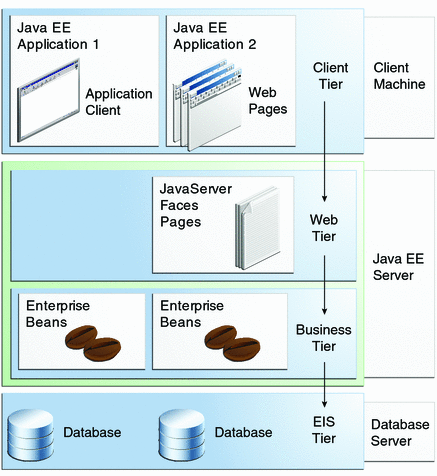
As shown in figure two multitiered J2EE applications divided
into the tiers described in the following:-
The Java EE
application parts shown in following Figure are presented in Java EE
Components.
· A Client-tier
components run on the client machine.
· And Web-tier
components run on the J2EE server.
· Also Business-tier
components run on the J2EE server.
· Enterprise
information system (EIS)-tier software runs on the EIS server.
Although a Java EE application can consist of all tiers
shown in Figure, J2EE multitiered applications are normally considered to be
three-tiered applications because they are distributed over three locations:
client machines and the J2EE server machine ,the database or legacy machines at
the back end. The 3-tiered applications that run in this way extend the
standard two-tiered client-and-server model by placing a multithreaded
application server between the client application and back-end storage.
Figure 1-1 Multitiered Applications
Security
Although other enterprise application models require
platform-specific security measures in every application, the J2EE security
environment enables security constraints to be defined at deployment time. The
J2EE platform makes applications portable to a wide variety of security
implementations by shielding application developers from the complexity of
implementing security features.
The Java EE platform provides standard declarative access
control rules that are defined by the developer and interpreted when the
application is deployed on server. J2EE also provides standard login mechanisms
so application developers do not have to implement these mechanisms in their
applications. A same application works in a different sort of security
environments without changing the source code.
Java EE Components
Java EE applications are made up of components. The Java EE
component is a self-contained functional software unit that is assembled into a
Java EE application with its related classes and files and that communicates
with other components.
The J2EE specification defines the following Java EE
components:
· App clients and
applets are components that run on the client.
· Java Servlet, JSF,
and JSP technology components are web components that run on the server.
· Enterprise
JavaBeans (EJB) components (enterprise beans) are business components that run
on the server.
Java EE components are written in the Java programming
language and are compiled in the same way as any program in the language. The
diff b/w Java EE components and “standard” Java classes are that Java EE
components are assembled into a J2EE application, these are verified to be well
formed and in compliance with the J2EE specification and they are deployed to
production, where they are run ,managed by the J2EE server.
Java EE Clients
The J2EE client is usually either a web client or an
application client.
Web Clients
A web client consists of two parts:
· Dynamic web pages
containing various types of markup language (HTML, XML, and so on), which are
generated by web components running in the web tier
· A web browser,
which renders the pages received from the server
A web client is sometimes called a thin client. And Thin
client usually do’nt query databases ,execute business rules, or connect to
legacy apps. When we use a thin client, such heavyweight operations are
off-loaded to enterprise beans executing on the J2EE server, where they can
lack in security, speed and reliability of J2EE server-side technologies.
Application Clients
An application client runs on a client machine and provides
a way for users to handle tasks that require a richer user interface than can
be provided by a markup language. The application client genrally has a
graphical user interface (GUI) created from the Swing or the Abstract Window
Toolkit (AWT) API, but a command-line interface is certainly possible.
Application clients directly access enterprise beans running
in the business tier. Well ,if application requirement warrant it, an
application client also can open an HTTP connection to establish communication
with a servlet running in the web tier. Appl clients written in languages other
than Java can interact with J2EE servers, enabling the J2EE platform to
interoperate with legacy systems, clients.
Applets
A web page received from the web tier can include an
embedded applet. In the Java, an applet is a small client application that
executes in the Java virtual machine installed in the web browser. client
system will likely need the Java Plug-in and possibly a security policy file
for the applet to successfully execute in the web browser.
Web components are the preferred API for creating a web
client program, it is because no plug-ins or security policy files are needed
on the client systems. The web components allow cleaner and more modular
application design because they provide a way to separate applications
programming from web page design.
The JavaBeans Component Architecture
The client and server tiers can also include components
based on the JavaBeans component architecture (JavaBeans components) to manage
the data flow between the following:
· An app client or
applet and components running on the Java EE server
· Server components
and a database
JavaBeans components can’t be considered Java EE components
by the Java EE specification.
JavaBeans components have properties and have get and set
methods for accessing the properties. The JavaBeans components used in this way
are typically simple in design and implementation but should conform to the
naming and design conventions outlined in the JavaBeans component architecture.
Java EE Server Communications
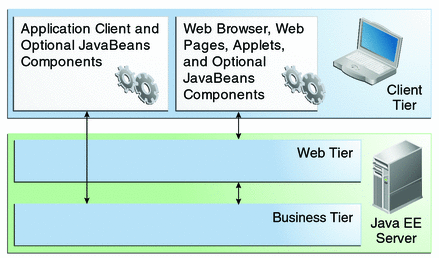
Figure 1-2 shows the various elements that can make up the
client tier. The client interects with the business tier running on the Java EE
server directly or, as in the case of a client running in a browser or also by
going through web pages or servlets running in the web tier.
Figure 1-2 Server Communication
Web Components
Java EE web components are either servlets or web pages
created using JavaServer Faces technology and/or JSP technology (JSP pages).
Servlets are Java programming language classes that dynamically process
requests and construct responses. Java Server Pages are text-based documents
that execute as servlets but allow a more natural approach to creating static
content. JSFtechnology builds on servlets and JSP technology and provides a
user interface component framework for web applications.
Static HTML pages and applets are bundled with web
components during application assembly but are not considered web components by
the Java EE specification. The Server-side utility classes can also be bundled
with web components and, like HTML pages, these are not considered as web
components.
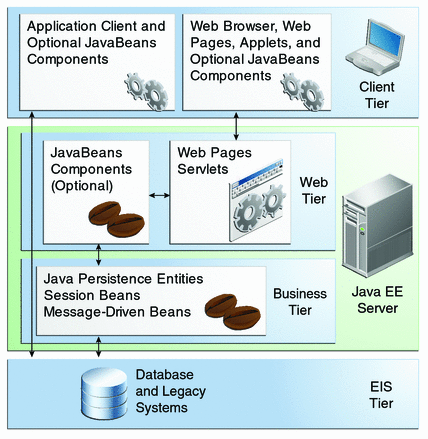
As shown in Figure , the web tier, like the client tier,
might include a JavaBeans component to manage the user input and send that
input to enterprise beans running in the business tier for processing.
Business Components
Business code, which is logic that solves or meets the needs
of a particular business domain like banking, retail, or finance, is handled by
enterprise beans running in either the business tier or the web tier. Figure
above shows how an enterprise bean receives data from client programs,
processes it (if necessary), and sends it to the enterprise information system
tier for storage. The enterprise bean also recieves data from storage,
processes it (if necessary), and sends it back to the client program.
Figure 1-4 Business and EIS Tiers


No comments:
Post a Comment